최종편집 : 2026.09.07 월 19:58
  All
All Society & Global


 Kim Ye-kyeong

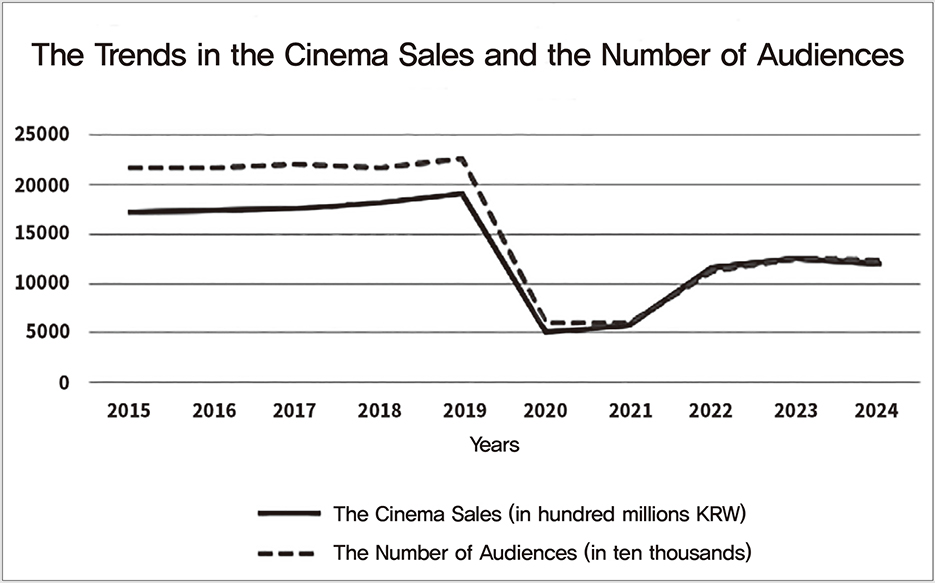
After reaching its peak in 2019 with the box office takings of 1.914 trillion KRW, the Korean film industry collapsed due to COVID-19, falling to 510.4 billion KRW in 2020—nearly a quarter of its takings in 2019. Although the industry appeared to recover in 2022, reaching 1.1602 trillion KRW, it still remains at only about half of its pre-pandemic level and faces a period of severe stagnation. A combination of factors contributes to slow recovery, including the rapid growth of OTT platforms such as Netflix, TVING, and Coupang Play, shrinking investment caused by weakening of profitability, a shortage of film content, and increasing production costs and ticket prices. This article covers the factors behind the crisis facing the cinema industry and directions for its future.
The Expansion of OTT Platforms and Changes in Movie Consumption
One of the biggest causes of the crisis is the change in audience behavior brought about by the growth of OTT platforms. According to the Korean Film Council (KOFIC), OTT platforms account for the largest portion of movie consumption across all age groups. In particular, many audiences pointed to high ticket prices as the biggest barrier to visiting cinemas, and the tendency for audiences to wait for films to be released on OTT platforms rather than watching them in cinemas is evident, largely due to the burden of expenses.
Currently, movie ticket prices for adults have risen to 15,000 KRW. This is the reason why out-of-cinema viewing culture has spread among people in their 20s and 30s who prioritize convenience and cost-effectiveness.
A (Cheongju, 23) said, “For students without a stable income, current ticket prices are a real burden. When I was younger, it was easy to say, ‘Should we go watch a movie?’ whenever I was bored, but, these days, I only go to the cinema when there is a film I really want to see.” In contrast, B (Cheongju, 64) said, “Compared to the young generation, seniors feel less of a financial burden, and those over 65 can watch movies for 9,000 KRW with preferential treatment for the elderly. Many of my friends often visit the cinema without worrying about expenses.”
In addition, the convenience of OTT platforms—free from time and space constraints—has led audiences to turn away from cinemas. Users can watch whenever they choose, with full control to play, pause, or skip. They can also enjoy films without noise or disturbance. As a result, OTT platforms have become infrastructure tailored to modern lifestyles, posing a serious challenge to the role of cinemas.
Decline in Quality and Diversity in Korean Films, a Vicious Circle
Consumers are not simply refusing to spend money because of high movie ticket prices. According to a survey by the KOFIC, 60.5% of respondents said, “I feel movie tickets are expensive when the film is not as entertaining as expected.” This explains why audiences tend to judge films more strictly in terms of large screen optimization and technical quality, including screen, sound, and direction. A expressed disappointment, saying, “If a movie is truly well-made, I would spare no cost. However, many recent movies feel shorter, a bit predictable, and boring.”
This decline in content quality is closely connected to the structural limitations of the Korean film industry. According to a report by the KOFIC, the domestic film industry is operated by a system in which investment distribution company and investment association procure production costs and then reinvest profits from released films into next films. However, as the release dates were delayed and market conditions worsened during the pandemic, profitability declined sharply. Investors became increasingly conservative, and investment distribution companies hesitated to plan new films. Audiences began expecting higher quality films in return for rising ticket prices, but production companies can no longer meet those expectations due to a lack of development budgets. It has formed a vicious circle. The KOFIC argues that bold government support is urgently needed in order to change this into a virtuous circle within the film industry.
Polarization within the film market and the subject matter is also becoming more pronounced. A report by the KOFIC points out that widening profit gaps have concentrated funding on commercially safe projects, making it increasingly difficult for rookie directors or fresh themes to secure investment from the outset. Meanwhile, a report of a research team of Park Chae-eun (2025) by the KOFIC emphasizes that independent and art films are an important foundation for diversity by introducing new ideas and new talent into the commercial film industry. However, the current imbalance within the industry is undermining content diversity. C (Cheongju, 24), who frequently watches independent films, explained, “Large commercial films dominate screens and are shown many times a day. On the other hand, independent or small and medium-sized films are often screened only once or twice a day. There were many times when I wanted to go to the cinema but could not watch the movie I really wanted to see. Eventually, there came a day when I stopped going to the cinema.”
Different Generations, Different Meanings of the Cinema
Despite these challenges, people still continue to visit cinemas for different reasons. The audiences interviewed by a CBT reporter described distinct values related to cinemas depending on their generation.
D (Uijeongbu, 16), who is a middle school student, described the cinema as part of a social outing with friends. D said, “Eating delicious food together, watching a movie at the cinema, and then talking about the movie at a cafe has become part of our routine when hanging out.”
A, who prefers animated movies, defined cinemas as spaces for immersion and exclusive experiences. A explained, “Sometimes I watch the same movie on several occasions to collect limited-edition specials provided each week. I can enjoy the sense of immersion given by the large screen and powerful sound, as well as the atmosphere of concentrating on a film together with my friends. I also watch movies in cinemas as soon as they are released to avoid spoilers on social media.”
B described, “The cinema is a space for emotional connection and vivid experiences to me. I usually visit cinemas once or twice a month with friends from the welfare center or with family to make memories together. Since I am interested in history, I always go to the cinema when historical films are released. The movie feels much more vivid and lively in the cinema than when watching movies at home, so I prefer to watch movies in cinema.”
However, every generation does not view the cinema positively. In particular, some people in their 30s and 40s said that childcare and working life have made cinema visits increasingly difficult.
E (Cheongju, 36) said, “It has been a long time since I regularly visited the cinema because of work. I once tried taking my child to see an animated movie at the cinema, but after about 30 minutes the child could not sit still anymore. Since then, I rarely go to the movies.”
Similarly, F (Cheongju, 45) explained, “I seldom go to the cinema, because going to the cinema itself feels inconvenient in a busy life. I have an eight-year-old daughter, but cinemas nowadays are so quiet that she became scared and we left after only 10 minutes. Eventually, watching movies comfortably at home through OTT platforms became a habit.”
The Cinema in Crisis: Searching for Survival Strategies
As audience decline continues, both the film industry and the government have been attempting various changes to revive cinemas. The Ministry of Culture, Sports and Tourism (MCST) has supported audiences through CULTURE DAY—introduced in 2014 and held on the second and last Wednesday of every month—which allows people to watch 2D movies at major multiplex cinemas for 10,000 KRW for adults. The MCST with KOFIC also distributed large-scale movie discount coupons in an effort to bring audiences back to cinemas. Budgets aimed at strengthening the production capacity of Korean films have also been significantly expanded. The MCST increased its 2026 film sector budget from 66.9 billion KRW—2025 film sector budget—to 149.8 billion KRW and supported budgets for mid-budget film production from 10 billion KRW to 20 billion KRW. In addition, the KOFIC started a new support project providing up to 800 million KRW for full-length and live-action films with net production costs between 1 and 2 billion KRW, as well as 83 million KRW for short live-action films with net production costs below 50 million KRW.
Cinemas themselves are also attempting to improve their business models. Cinemas are increasingly expanding premium movie screens such as IMAX, ScreenX, and Dolby Cinema—experiences that OTT platforms cannot fully replicate. Cinemas are also evolving into VIEWING PARTY spaces by broadcasting live concerts by major artists and live sports events. In addition, discussions surrounding the legalization of a HOLDBACK—delaying the release of films on OTT platforms for a certain period—are also continuing within the industry.
The crisis in the film industry is the result of multiple interconnected factors, including changes in movie-watching platforms, shrinking investment, and a lack of diversity in film content. To address these challenges, structural reform across the entire industry would be necessary. Rather than viewing OTT platforms and cinemas as competitors in a zero-sum relationship, the industry needs to build an ecosystem in which consumers can choose them as being complementary. Cinemas may need to move beyond being simple screening spaces and become places that offer exclusive immersion and unique cultural experiences. At the same time, stable investment environments could help improve the quality and diversity of films. Through these efforts, cinemas may be able to maintain their place as culturally meaningful spaces in the future.
By Kim Ye-kyeong
ykk623315@chungbuk.ac.kr


 Quick News