최종편집 : 2026.10.19 월 17:57
  All
All Society & Global


 Kim Seo-yeon
Recent shifts in the U.S. politics have coincided with increasingly stricter policies affecting international students. Discussions surrounding stricter F-1 visa screening and employment visa barriers are seen as going beyond administrative procedures and closely reflecting the current political atmosphere.
In particular, the Trump administration’s second-term emphasis on America First and MAGA (Make America Great Again) has brought international student policy to a core political issue, rather than treating it as institutional adjustments.
This policy direction is often interpreted as aligning with a strategy to leverage international student regulations as a political and social message.
The Targeting Strategy of MAGA Politics: Why International Students?
Koo Bon-sang (professor, Dept. of Political Science and International Relations) explained the political logic inherent in international student policies as populist dichotomy.
Prof. Koo stated, “The essence of Trump politics is populism,” adding that “Populists contrast the pure people with the corrupt elite, and tend to pursue hardline immigration policies by targeting immigrants or international students, whom they frame as external threats.” In other words, he argued populists attribute the economic and social hardships Americans face to elite groups and indiscriminate immigration, rallying their base by promising to fix these problems.
Prof. Koo pointed out that recent restrictions on international students are more likely political measures targeting specific universities and countries rather than comprehensive controls. He noted, “Historically, the U.S. actively welcomed international students, viewing the attraction of global talent as a national strength. The current trend diverges from this.”
A prime example is Harvard and other elite universities. Prof. Koo explained, “Elite institutions like Harvard are perceived by Trump supporters as so-called ‘hotbeds of left -wing ideology.’ The claim that high proportions of foreign students lead to reverse discrimination against American students carries significant populist appeal among supporters, making these universities easy targets for attack.”
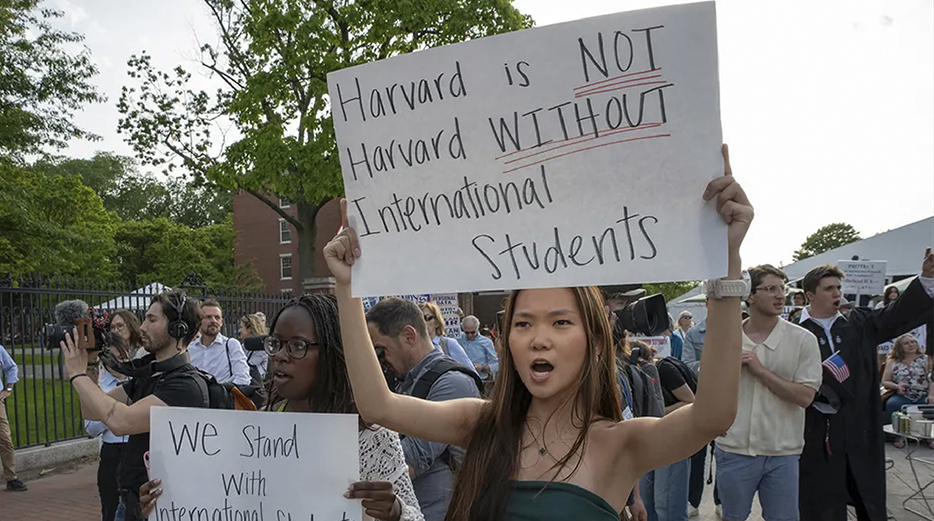
▲ People holding up signs during the Harvard Students for Freedom rally in aid of international students at the Harvard University campus in Boston, Massachusetts, on May 27, 2025.
Strengthened Management of International Students in Heightened Geopolitical Tensions
The tightening of international student policies is closely intertwined with the current state of geopolitical tension. Prof. Koo stated, “The proportion of students from China and India among international students is currently very high, particularly prominent in STEM fields,” adding, “Given the U.S.’s characteristic close linkage between advanced industries and university research, Chinese students often become a focus of concern over potential technology leakage.” He added, “The Biden administration has already pursued policies limiting the number of Chinese students, and Trump administration has taken a stance of responding more aggressively in competition with China.”
These changes are already being felt on the ground. Kim, a Korean student in the U.S., shared, “Over the past year or two, immigration questioning has become significantly more detailed and stringent. I have also experienced longer processing times and more complex documentation requirements during visa issuance and renewal. While tensions have somewhat eased compared to the peak period when visa cancellations surged, anxiety remains pervasive among international students.
Is America Weakening Its Own Strength Through Choice?
Prof. Koo warned that the decline in international student enrollment could undermine the U.S. competitiveness in the long term.
He emphasized, “America’s core competitiveness stems from diversity and inclusivity,” adding, “A decrease in foreign talent inevitably weakens not only university competitiveness but also the innovation capacity of industry.” As the U.S. universities serve as pivotal hubs connecting industry and research not merely as educational institutions, disruptions in talent recruitment can translate directly into diminished competitiveness in cutting-edge fields, according to the analysis.
This policy uncertainty is also affecting individual international students’ career decisions. Kim revised her original career path due to the volatility of visa policies. She stated, “I had planned to build my career in the U.S. as much as possible before returning home, but the policy changes and uncertainty experienced in recent years have forced me to reconsider my long-term plans.” She is now considering returning to Korea immediately after completing graduate school. This decision appears to be driven not only by unpredictable policies but also by the significant daily stress of living as a foreigner.
Studying Abroad: Now Is Time to Consider Policy Risk
Voices from the field and expert analysis converge on a shared message. While studying in the U.S. offers world-class education and opportunities, it is no longer seen as the predictable, smooth path it once seemed to be.
Kim advised prospective students: “Rather than holding vague expectations like ‘there will be many opportunities in the U.S.,’ you must carefully examine the rapidly changing policy environment and plan your long-term career path accordingly.”
Amid the global trend toward stricter immigration policies, international students are increasingly exposed to policy changes. Now, studying abroad has become a highly strategic decision that requires attention to international politics and policy variables, going beyond a simple academic choice.
By Kim Seo-yeon
ssung@chungbuk.ac.kr


 Quick News