최종편집 : 2026.10.19 월 17:57
  All
All Society & Global


 Kang Sung-eon
Last year, 33 out of 178 students in the School of Interdisciplinary Studies at CBNU chose the Dept. of Chemical Engineering. This number is even higher than the department’s own entrance quota of 32 students. Students do not decide their major when they enter university, and during their university life they find the major that fits their aptitude and career path by themselves. This is the purpose that the self-directed major system has promoted. In Jan. 2024, after the Ministry of Education announced an incentive policy for self-directed majors, this system, which aims to guarantee each student’s right to choose, spreads quickly. In the University Innovation Support Project, the extra points given for the number of students in self-directed major admission units rose from 10 points in 2024 to 15 points in 2025. The extra points in the National University Development Project, which targets regional flagship national universities and national key universities, also jumped from 8 points in 2024 to 12 points in 2025. Given that a difference of a few points in the evaluation of financial support projects can determine the amount of money a university receives, universities were given a strong financial incentive to increase their self-directed major quota. As a result, the ratio of major-undeclared admissions at universities across the country jumped more than four times in one year, from 6.6% in the 2024 school year to 28.6% in the 2025 school year.
However, unlike the proclaimed purpose of freedom of choice, the real choices of students were concentrated in a few departments. According to the data obtained by Korea Higher Education Research Institute, among the students in CBNU’s School of Interdisciplinary Studies, 33 students entered Chemical Engineering, 19 students entered the School of Business Administration, and 17 students entered the School of Electrical Engineering. The number of students who entered these three departments accounted for 38.8% of all 178 students. This issue is not unique to CBNU. According to the same data, at the School of Interdisciplinary Studies of Kyung Hee University (KHU)’s Global Campus, 162 out of 198 students (81.8%) entered the top three departments. At Seoul National University (SNU), 140 out of 172 students (81.4%) in the College of Liberal Studies and the broad-field admission group were concentrated in the top three colleges: the College of Engineering, the College of Social Sciences, and the College of Business Administration.
Concentration in Popular Departments Spreads Across the Country
The concentration is not limited to one school or one department. The Korea Higher Education Research Institute made requests for information disclosure to 12 private universities in the metropolitan area and 8 regional flagship national universities including SNU. The results showed that in most of the universities in the survey, the top one to three departments accounted for more than half of all the students who chose a major. Sungkyunkwan University reached 77.2%, and Kwangwoon University(KW) reached 67.0%. The concentration in the electrical and electronics engineering fields was especially clear. At KW, 163 students entered the Dept. of Electronic Engineering, which is more than its 2025 entrance quota of 114 students, amounting to 143% of the quota. Kookmin University’s Dept. of Visual Communication Design also reached 188.6% of its entrance quota of 35 students.
Looking into how CBNU runs its self-directed major system reveals why this concentration was possible. According to the guidelines for assigning departments to students without a declared major, CBNU runs the School of Interdisciplinary Studies in two ways. In the School of Interdisciplinary Studies under the College of Creativity and Convergence, students can choose a department without a limit on the number of students admitted to each department. On the other hand, in the Schools of Interdisciplinary Studies that belong to each college, such as humanities, social sciences, and business administration, the number of students assigned to a department cannot exceed 150% of the entrance quota, and if it goes over, students are assigned in the order of their grade point average.
Kim Dae-won, a visiting professor of the School of Interdisciplinary Studies at CBNU, explained that this two-track structure is the result of following the Ministry of Education’s policy guidelines. He said, “The School of Interdisciplinary Studies under the College of Creativity and Convergence does not have a quota limit because it follows the purpose of Type 1, which guarantees the students’ right to choose as much as possible. The Schools of Interdisciplinary Studies within each college have a 150% limit because they follow the purpose of Type 2, which considers the education conditions inside the college, such as the number of professors and available classrooms.” He also said, “It is true that if students are concentrated in one department in Type 1, which has no quota limit, it can put a burden on education conditions, such as classroom space and laboratory equipment.”
Meanwhile, there are also departments that students in the School of Interdisciplinary Studies cannot choose from the beginning. According to the guidelines for assigning departments, the Dept. of Philosophy, Dept. of History, Dept. of Russian Language and Culture, Dept. of Sociology, Dept. of Political Science and International Relations, Dept. of Astronomy and Space Science, and Dept. of Earth and Environmental Sciences are excluded from the available choices. For departments like the College of Education, the College of Medicine, and the College of Nursing, the reason for the exclusion is clear, because they need a national examination or a separate curriculum. However, for the departments above, the reason is not clearly shown in the guidelines alone. Regarding this, Prof. Kim answered, “The decision on whether a department can be selected depends on multiple factors working together, such as the university’s quota management, the capacity of professors and facilities, and the rules of academic operation,” and added, “There are parts that are hard to explain only from the perspective of the School of Interdisciplinary Studies.”
CBNU also strengthened the prerequisite course requirements for some popular departments, starting with the students who enter in 2026. In the case of the School of Electrical Engineering, there are five basic science courses: Mathematics I, Mathematics II, General Physics and Experiment I, General Physics and Experiment II, and General Chemistry and Experiment. The number of these courses that students must take increased from two courses for 2025 students to four courses for 2026 students. Prof. Kim explained, “Seeing it as a barrier to stop the concentration is different from the purpose of our operation” and “if students enter a major without basic knowledge, they may not be able to follow the classes, so the purpose is to help students assess their own preparation and aptitude.”
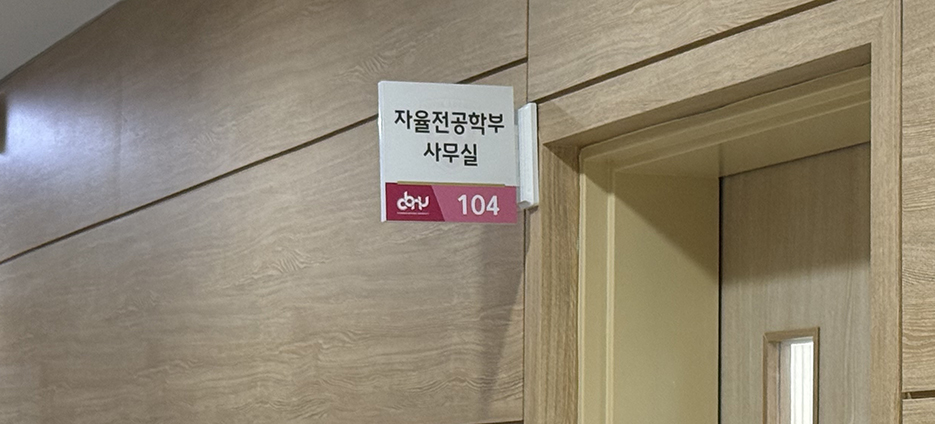
▲ The School of Interdisciplinary Studies office
Feeling Left Out After Choosing a Major
Lee Da-yeon (Dept. of Safety Engineering, 25), who moved from the School of Interdisciplinary Studies at CBNU to the Dept. of Safety Engineering, said, “Unlike other departments, we do not have a sports day or department events, so there are few chances to socialize and build rapport with classmates, seniors, and juniors. Also, everyone takes different classes, so it is hard to develop a sense of connection with classmates. After entering the department, it is not easy to close the gap with the other students and to fit in the atmosphere of the department. If I could go back, I would enter the department directly from the start.”
To address the sense of exclusion experienced by self-directed major students, KHU allows the students who already chose a major and moved to a department to continue participating in activities in the student council of the School of Interdisciplinary Studies, under the name Ppuri-Jajeon, which means the roots of the self-directed major track. It also holds The Night of Jajeon People, a meeting with graduates, every Dec. In this way, the university keeps an official channel open so that the students can maintain a sense of belonging. Lee Seok (the class representative of KHU’s School of Interdisciplinary Studies, 26), said, “Even after entering a major, we keep doing activities such as working as officers of the student council under the name Ppuri-Jajeon, and we build a bond between seniors and freshmen. There are many activities with seniors at the freshman orientation camp and at the events of the clubs affiliated with the School of Interdisciplinary Studies.”
Prof. Kim Dae-won said, “Right now, the fourth-year students entering the School of Interdisciplinary Studies have low satisfaction with their school life. However, these students did not enter through today’s method, which guarantees a broader right to choose majors without quota limits, and the number of students admitted at that time was also small. After they moved into their respective departments from their second year, I think many students felt psychologically left out while adjusting to students who were already in the department. The follow-up counseling system for students from the self-directed major track is relatively weak. We need a continuous student care system that does not stop at supporting the major choice in the first year, but continues to monitor their academic progress after they move on to the second, third, and fourth years, and keeps supporting career counseling and networking between seniors and freshmen.”
The promise of the self-directed major system was clear; entering university without deciding a major, and finding a field that fits one’s aptitude and career path. However, statistics from universities across the country show that students’ choices are converging on a small number of popular departments. Moreover, some students who chose their major through the self-directed major track struggle to fit into their departments and feel excluded. Is this system, which promised to allow students to find a major that fits their aptitude and career path during university life, really achieving its goal?
By Kang Sung-eon
reverse0423@chungbuk.ac.kr


 Quick News