최종편집 : 2026.09.07 월 19:58
  All
All People


 Kim Seo-yeon

There is someone who sees the region not just as a place, but as a starting point for creation. Lee Ock-su, the CEO of the Cheongju-based local content group WANDERLUST, creates new cultural content by documenting the landscapes of the region and the stories of its people.
Q1. Please introduce yourself and WANDERLUST.
Hello, I am Lee Ock-su, the CEO of WANDERLUST. WANDERLUST is a local content group based in Cheongju and North Chungcheong Province (Chungbuk) that documents and expands the everyday lives, people, memories, and cultural resources of the area through various forms of content. We reinterpret local stories in diverse ways through merchandise, publishing, events, education, travel and tourism, and international collaboration.
Rather than viewing the region as a small or peripheral place, WANDERLUST sees it as a starting point where change, creativity, and exchange begin. Old alleyways, fading signboards, the small memories of local residents, and even scenes from ordinary daily life can become complete worlds in themselves and meaningful sources of creative inspiration for someone. WANDERLUST’s role is to discover these small and quiet worlds, reinterpret them in new ways, and share them once again with people.
Q2. What inspired you to start WANDERLUST?
While traveling through places such as Malacca in Malaysia, Chiang Mai in Thailand, and Pakse in Laos, I was deeply impressed by how the unique atmosphere of each neighborhood and the everyday lives of local people naturally became cultural content, rather than the large-scale tourist attractions. Independent magazines documenting alleyways, postcards capturing the scenery of old markets, and travel programs run by local residents showed me how ordinary daily life itself could become culture. Through those experiences, I realized that Cheongju and Chungbuk also hold stories that are equally beautiful and compelling.
After returning to Cheongju, I began walking through the city, observing it closely, and documenting what I saw to transform those experiences into new forms of content. What started with small-scale merchandise and archival projects gradually expanded into travel programs, board games, arts and cultural education, and international exchange projects. Over time, those efforts naturally grew into what WANDERLUST is today.
Q3. Is there a particular reason why you chose to document the stories of Cheongju and Chungbuk?
Cheongju and Chungbuk are more than simply the places where I live. They are spaces where the memories and sensations of my life have accumulated most deeply. The roads I have walked countless times, the familiar landscapes, and the memories of people I have repeatedly encountered all become an important backdrop that shapes my life.
When you take the time to look closely at a region, its unique culture and stories naturally begin to appear through scenes such as old markets, the seasonal changes along the Musimcheon Stream, the atmosphere of each neighborhood, and the everyday lives of local residents. WANDERLUST does not aim to leave the stories of Cheongju and Chungbuk merely as local archives. Instead, we continue to reinterpret them through a contemporary perspective and transform them into new forms of content.

Q4. Could you tell us about the magazine production process and how you choose which local stories to feature?
The process begins with slowly walking through and observing the region. We experience the atmosphere of neighborhoods firsthand, listen to the way people speak, notice the traces left in old spaces, and observe how the scenery changes with the seasons. From there, we collect stories and shape them into a cohesive narrative through interviews, photography, writing, and design. Throughout this process, we think carefully about how to capture and preserve the unique sensibilities and emotions of each place.
We also work on documentation projects together with local youth. For the past three years, we have been producing the regional magazine Local Creating with students from Sannam High School and Bongmyeong High School. Through the project, students directly research their communities, conduct interviews, and learn to view the neighborhoods they live in from a new perspective.
In addition, we have continued experimenting with various projects, including crowdfunding campaigns for regional magazine production and publishing magazines that share stories of exchange between Korean and Turkish students. Through these efforts, we have come to value local records that will remain meaningful over time, rather than simply focusing
on stories that are temporarily famous or attention-grabbing.
Q5. What was the intention behind creating goods inspired by local cultural resources?
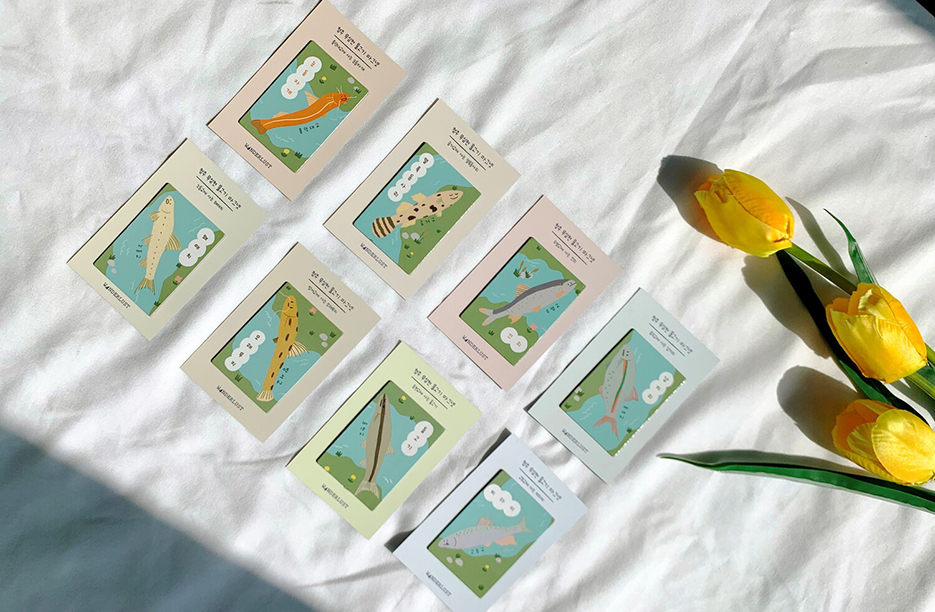
I believe that local cultural resources do not necessarly have to be presented in a difficult or heavy way. People tend to remember places more deeply through the process of touching, using, and engaging with something themselves, rather than simply listening to explanations. With that in mind, I wanted to reinterpret local stories into content that people could naturally encounter in their everyday lives, and our merchandise and board games emerged from that idea.
For example, the board game based on Cheongju’s modern cultural heritage was designed so that people could naturally learn about the region’s history and places through play. Likewise, goods featuring Musimcheon Stream and local landscapes are not simply souvenirs but mediums that bring the sensibility of the region into everyday life. We hope that local content will not be consumed only in a specific place and forgotten but instead continue to remain within people’s daily lives.
Q6. Is there a story from a local resident that particularly stayed with you during your work?
There is a woman in Uncheon-dong who has worked as a Yakult Fresh manager for more than 20 years. Listening to her story of beginning each day by walking the same alleyways and meeting familiar faces made me realize that a person’s labor can become more than just a means of making a living. It can also sustain the rhythms and relationships of an entire neighborhood.
On the surface, her work may seem ordinary, but within it, there were daily greetings, trust built over many years, and the changing scenery of the neighborhood across the seasons. In her memories, there were the well-being of elderly residents, the gradual transformation of alleyways, and the moments of children growing up. Through her story, I came to believe that regional documentation does not always need to center on extraordinary events or famous figures. Rather, the perspective of someone who has faithfully passed through the same place every day may be one of the closest and most authentic ways to capture the essence of a community.
Q7. What do you consider most important when turning local everyday life and stories into content?
The most important thing is the attitude of looking at people. What matters in local content is how sincerely it captures the time, emotions, and relationships of the people living within that space. That is why, no matter what kind of content we create, we first take the time to slowly walk through the region and listen carefully to people’s stories.
Even during interviews and documentation, we try not to overly embellish or dramatize people’s lives. Instead, we focus on naturally conveying each person’s unique way of speaking, their atmosphere, and the texture of their everyday life.
Q8. Lastly, is there anything you would like to say to CBT readers?
I hope people do not take the places and moments they are living in right now for granted. College days pass more quickly than we expected. The streets around campus and the places people casually visit with friends may later become some of the most meaningful memories of their lives.
That is why I believe it is important to develop the ability to observe and record those ordinary moments for oneself. As the saying goes, “The most personal is the most creative.” The stories and sensibilities discovered in the places closest to us can ultimately connect to a much wider world. I hope readers will take a closer look at their surroundings with greater curiosity and attention. Possibility does not begin in some distant and extraordinary place but within everyday life closest to us.
By Kim Seo-yeon
ssung@chungbuk.ac.kr


 Quick News