최종편집 : 2026.10.19 월 17:57
  All
All Experience


 Kang Yeo-min
Have you ever ended your day unable to put down your phone before bed? For a CBT reporter, it was common to fall asleep while watching videos or reading interesting posts. At first, the reporter picked up the phone just to find something to watch for a moment. Aimlessly scrolling through various apps had become part of the nightly routine.
To change this habit, the reporter tried a 14-day “cortisol detox.” Cortisol is a hormone that helps the body respond to stress. This article is a personal record of an experiment: Could simple daily rituals help quiet stress signals, even if only for a moment?
Signals From the Body, Three Resolutions
The stress that built up during the final exam period of the first semester led the reporter to try this experiment. All of the delayed studying, personal paperwork, and plans with friends came together at once. The reporter felt overwhelmed, and had trouble digesting food. It was a moment when the body noticed the buildup of stress before the reporter fully realized it.
The reporter selected three missions that could be accomplished without turning her entire life: ▲ Stretching right after waking up ▲ Taking a 15-minute walk after lunch ▲ Staying off the phone for 20 minutes before bed. Although the morning and lunchtime missions were fairly easy, breaking the habit of falling asleep while using the phone was the hardest challenge.
Trying to stick to the plan perfectly for 14 days felt overwhelming, so the reporter scaled it back thinking, “Let’s just try it for three days first.” Every day, the reporter wrote down the morning mood, time, place, weather of the walk, and the overall mood on a scale of 1 to 10. On the first day, the mood score was 5.0. Walking made the reporter feel a little better for a while, but at night, the reporter grew restless, unable to watch videos or scroll through posts.
During the first week, the missions felt like cumbersome duties. However, by the next Monday, the reporter felt that stretching seem to help the body loosen up a little faster. It was not a huge change, but the difference in how the body felt gave the reporter a reason to continue. On the last day, the mood score was 8.5 out of 10. This number cannot prove that the cortisol level actually changed or that stress really decreased, but the reporter’s mood did change.
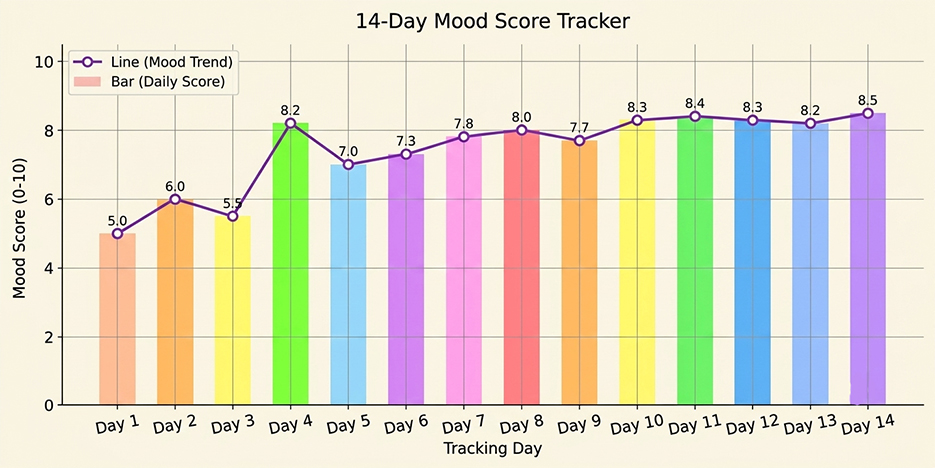
▲ 14-Day Detox Mood Tracker
15 Minutes on the Tree-Lined Path by the Main Gate at CBNU
Of the three missions, the lunchtime walk was the one that stayed with the reporter the longest. At first, the reporter only focused on walking for the full 15 minutes. However, during the second week, the temperature rose to 37 °C. Walking under the strong sun was difficult, so the reporter spent 5 minutes walking in the sunlight and the other 10 minutes following shaded paths.
During those walks, the reporter wandered onto a tree‑lined path beside the lawn near the Main Gate at CBNU—a spot rarely visited before. Because of the shade of the huge and dense trees, the air felt cooler even on hot days. The short time, the reporter spent walking and taking in the scent of the trees, did not feel like laziness or avoidance; instead, it felt like a small reward she was giving herself.
Research has also found that forest settings can be associated with calmer physical responses. A research team led by Park Bum-jin at Japan’s Forestry and Forest Products Research Institute conducted field experiments in 24 forests in Japan. They compared participants’ physical responses in forest and city environments. According to a study published in Environmental Health and Preventive Medicine in 2010, cortisol levels in saliva were lower in forest settings than in urban settings. They were 13.4% lower after people looked at a forest and 15.8% lower after they walked in one. Additionally, the researchers observed changes linked to relaxation in blood pressure, pulse rate, and heart rate variability.
Of course, the reporter cannot say that a tree-lined path on campus has exactly the same effects as a forest in a research study. Still, nature on campus can give students a place to pause and look away from their busy lives without traveling to a large forest. For the reporter, the path near the main gate became more than a route for spending 15 minutes. It became a place to slow down, check her own pace, and recharge during a busy day.
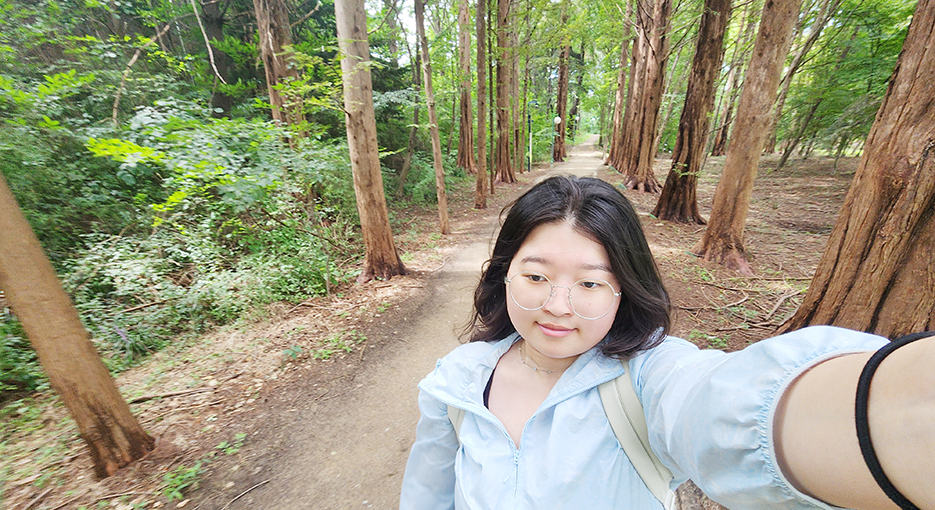
▲ A tree-lined path near the main gate
20 Minutes Beyond the Screen
Staying off the phone for 20 minutes before bed was the most difficult mission. The reporter was used to lying in bed, watching videos and reading posts until she drifted off to sleep. On the first night, the reporter charged the phone on the desk instead of beside the bed. Her hands felt empty, and the reporter worried that she might not hear the morning alarm. Even after turning off the light, her eyes kept moving toward the place where she had left the phone.
The reporter used those 20 minutes to write in a journal and read. At first, small sounds that the reporter usually did not notice such as the sound of motorcycles outside, seemed much louder. It was unfamiliar. However, after a few days, the quiet became a peaceful part of the bedtime routine.
On the fourth night, messages from friends kept lighting up the phone screen. The reporter closed her eyes without checking them and thought, “Let’s read the funny stories and laugh tomorrow.” The next day it turned out that none of the messages were urgent. Those 20 minutes of delaying checking the phone did not mean losing touch with people. Instead, they became a moment for the reporter to care for herself, before returning her attention to others.
There is also research on the relationship between light-emitting screens and sleep. In 2018, a research team led by E. D. Chinoy compared two activities among nine healthy adults over five days: Using a tablet freely at night and reading printed material. When participants used tablets, they went to bed about 30 minutes later on average, and they fell asleep later as well. They also felt less alert the next morning. This study does not explain every experience of using a phone, but it suggests that screen light and content before bed can affect our sleep rhythm.
In the later part of the experiment, those 20 minutes at night were no longer just an empty space where the reporter had to resist using the phone. The reporter recorded her mood and walking activity, then lightly organized the next day’s schedule and tasks. On nights when she had trouble sleeping, she read more or stretched her neck and shoulders. Without the glow of a screen, her eyes felt less dry and she felt that she slept more deeply.
Small Gaps, Not Perfection
Even after 14 days, the three resolutions had not become perfect habits. Some days, the reporter wanted to skip the walk or spend more time on the phone. Nevertheless, the reporter did not be disappointed. This experiment was less about building a perfect routine and more about practicing how to recognize signals from her body and mind.
One thing that impressed her was that the reporter could adjust each of the three challenges to fit different situations. During extreme heat, the reporter walked in the shade. On days when it was hard to go outside, the reporter looked at nature through a window or stretched indoors. If the reporter missed the morning stretch, she gently loosened her neck and shoulders while moving from place to place. A routine is not a rule that becomes a failure when it cannot be followed perfectly. It is a process that can be adjusted to fit one’s circumstances on that day.
If stress persists and you continue struggling with sleep, digestion, anxiety, or low moods, small routines alone may not be enough. Asking for help to someone you trust, a school counselor, a health service, or a medical professional is also a way to care for yourself. Try walking for even five minutes to a place where you can see trees and grass. Pause in the shade, take a breath, and notice the changing light and the smell of trees. That small break may be the first step toward checking in with yourself again in the middle of a busy life.
By Kang Yeo-min
yeomin@chungbuk.ac.kr


 Quick News