최종편집 : 2026.10.19 월 17:57
 All
 People


 Kim Ye-kyeong


Q1. Please introduce yourself and tell us about The Environmental People.
Hello, my name is Kim Deok-won (Dept. of Environmental & Biological Chemistry, 15). After completing a master’s degree from the Dept. of Agricultural Chemistry, I am currently pursuing a doctoral degree in the Dept. of Earth Resources and Environmental Engineering at Hanyang University. As a microalgae researcher, I also go by the name “Algae Doctor” and serve as a co-representative of The Environmental People.
The Environmental People is an environmental community that connects research knowledge with civic activity. It began as a small group in Sept. 2024 and became a nonprofit organization in March 2025. Its goal is to address environmental issues by connecting research, policy discussions, and civic activities. I am conducting a study and acting as a bridge between research and society through education, science communication, and content creation.
Q2. What motivated you to begin environmental activities outside the laboratory?
While researching water purification using microalgae in graduate school, I was curious about their other potential applications. In particular, I began studying how their ability to absorb carbon dioxide through photosynthesis could contribute to addressing climate change.
As I learned more about the climate crisis, I began to feel a gap between the laboratory and reality. Although research is also vital, I wanted to do something that could directly help people. This motivated me to embark on science communication and civic activities.
In 2022, I introduced my research on microalgae at FameLab Korea and advanced to the finals. I was later appointed as a science communicator by the Korea Foundation for Science and Creativity. Since then, I have expanded my activities through lectures and Climate Fresk workshops. I have also proposed environmental policies on the Seoul Youth Policy Network. At The Environmental People, I am observing how the climate crisis affects people’s mind, researching climate anxiety and depression among youth.
Q3. How do you combine both research and environmental activities?
On weekdays, I conduct experiments and analyze data in the laboratory. I am working with a company on research into converting microalgae into bioenergy through hydrothermal liquefaction at the moment. This research uses water at high temperatures and pressures to convert microalgae into biocrude. Biocrude is a substance similar to crude oil. While it has the potential to reduce the energy required to dry the raw material, we also need to evaluate the efficiency and stability of the process and the quality of the products. I also examine how the technology developed in the laboratory can be implemented on a larger scale.
On weeknights and weekends, I act as a co-representative of The Environmental People. I introduce environmental issues, research findings through various forms of content, and develop civic education and communication programs. I also coordinate schedules, venues, and roles with partner organizations. After each activity, I review what could be improved and incorporate those revisions into future programs.
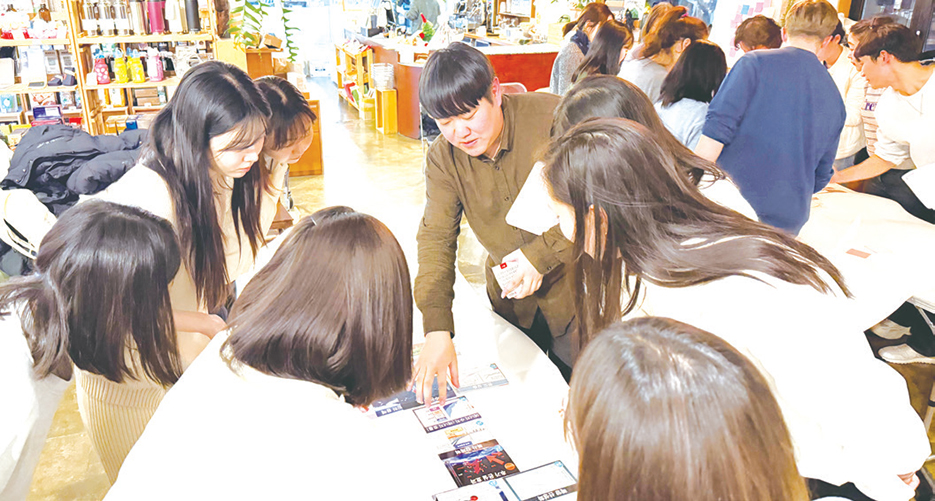
▲ Climate Fresk Workshop.
Q4. What is the most challenging part of running The Environmental People, and how are you improving it?
Bringing people together is challenging, but it is even more difficult to turn one-time participation into sustained engagement. It is not always easy for participants to make time in their daily lives, even though they empathize with environmental issues. Accordingly, we offer a variety of opportunities, including discussions, educational programs, and hands-on activities, so that first-time participants can find a way to get involved based on their interests.
One of our main activities is “Hwansaengting”, a monthly gathering where members and people from outside the organization come together to discuss environmental issues. Participants can take part in activities according to their interests, whether in research, policy, education, or activism.
Q5. Among the policies you proposed through Seoul Youth Policy Network, which one stands out in your memory the most?
It is “Reducing Waste Through Promoting Waste Separation.” The proposal is that a youth participation group record the amount of waste generated by category and create waste separation guides and social media content to encourage proper disposal, focusing on Gwanak-gu, in Seoul, where young people live alone. We also suggested comparing the amount of waste generated before and after the program and providing Eco-Mileage benefits based on participation levels and achievements.
It was meaningful that the proposal translated an environmental issue into a local life issue and allowed young people to measure the changes themselves. Going forward, I would like to follow the evaluation results and subsequent discussions. If the proposal is implemented in real life, I will assess whether it actually leads to greater civic participation and waste reduction and make further improvements based on the results.
Q6. What are microalgae and algal bloom? Can microalgae be used to solve environmental problems?
Microalgae are microscopic algae that are too small to be seen clearly with the naked eye. Many microalgae photosynthesize and support aquatic food chains.
On the other hand, an algal bloom occurs when certain organisms increase excessively, causing the water to turn deep green. Such bloom can arise when excessive amounts of nutrients, such as nitrogen and phosphorus, enter the water and environmental conditions, including water temperature, light, and water flow, are favorable. Cyanobacteria are often involved in these blooms. Although they are commonly referred to as blue-green algae, they are exactly bacteria that carry out photosynthesis.
Severe algal blooms can prevent sunlight from penetrating the water. As the organisms die and decompose, dissolved oxygen levels decrease, putting stress on the aquatic ecosystem. Some cyanobacteria produce toxins. However, not all microalgae or algal blooms are toxic. Therefore, it is important to check which species are present, how much they have proliferated, and whether they produce toxins.
When properly managed and cultivated, microalgae have the potential to remove water pollutants, treat wastewater, and produce feedstocks for aviation biofuel. However, to evaluate whether they are truly environmentally beneficial, I must also take into account the energy consumption, costs, and greenhouse gas emissions associated with the entire process, from cultivation to fuel conversion.
Q7. How is Machine Learning used in research, and what advice would you give to university students who want to learn it?
Environmental data involve complex interactions among various factors, including water quality, climate, and cultivation conditions. Machine learning is a tool that helps identify patterns and key factors in such data and make predictions.
In my research on microalgae-based bioenergy, I analyzed the relationships between cultivation conditions and production outcomes. Also, in a study related to the cultivation of Chlorella vulgaris, I developed a predictive model using 18 variables, including light intensity, pH, and salinity, and identified the key variables influencing the results.
For students who are just starting out, I recommend first mastering basic statistics and fundamental concepts in their own fields. After that, they can practice organizing tabular data and visualizing it using Python. They can also use Pandas and Scikit-learn to build simple predictive models. Asking AI tools to explain concepts or help identify coding errors is useful. However, it is crucial to understand what the code does and to develop the habit of evaluating results by separating model training data from performance test data.
Q8. What can university students who are hesitant to take environmental action do to start right now?
You do not need to start with a large-scale project. Try plogging—picking up litter while walking—with one or two friends around campus or along the Musimcheon Stream walking paths. Recording the types of litter you find and where they accumulate can help you identify specific environmental problems in your local area. Seeing your surroundings change will give you confidence that even small actions can make changes.
You can also turn the problems you observe into proposals for civic action. For example, you can submit ideas through Cheongju’s participatory budgeting program or citizen proposal channels. Rather than simply requesting more cleanup efforts, you can suggest initiatives that address the sources of waste such as making reusable containers easier to borrow and return at local events. I encourage students to start with small actions, identify problems in their communities, and gain experience working with others to propose solutions.

By Kim Ye-kyeong
ykk623315@chungbuk.ac.kr


 Quick News