최종편집 : 2026.10.19 월 17:57
  All
All Feature


 Bae Young-jun
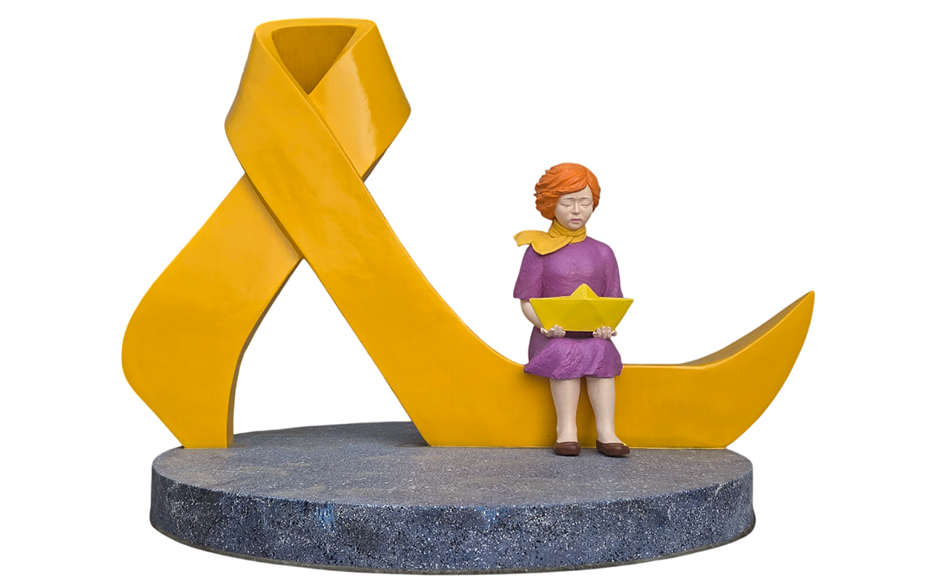
The warm scent of spring and flowers in full bloom greet April—the month when students of Danwon High School, full of dreams, left this world as beautiful yellow butterflies. On the 12th anniversary of the Sewol Ferry Disaster, CBT reporters visited the Danwon High School 4.16 Memorial Classroom, operated by the 4.16 Memory Archives, to reflect on the meaning of the tragedy.
The 4.16 Memory Archives began shortly after news of the Sewol Ferry’s sinking broke by citizens, scholars, and experts who gathered voluntarily with one shared conviction that the disaster had to be preserved in records. Archiving efforts soon followed to collect and organize the flood of memorial records pouring in from across the country. Civil organizations joined the family countermeasures committee formed by the bereaved families in July 2014, and donated the records they had collected. Together with the bereaved families, they raised donations and funds through The Beautiful Foundation to preserve and make use of the records. In Aug. 2014, the 4.16 Memory Archives was established under the slogan “Remember, Record, Act.” It is a place that conveys the tragedy as one shared by all of society and seeks communal healing through memories and records accumulated over many years from the diverse perspectives of victims and citizens.
Operating as a non-govermental organization, it is run entirely on citizen donations without government support. For the past 13 years, it has operated the pilgrimage route “Path of Memory and Promise” guided in person by bereaved mothers. The path connects the Danwon High School 4.16 Memorial Classroom to the 4.16 Memorial Park. The Danwon High School 4.16 Memorial Classroom and its related Sewol Ferry records held by the 4.16 Memory Archives are registered as State-Designated Records No. 14 and No. 14-1, respectively. The 235,220 collected records are also scheduled to be submitted for inclusion UNESCO’s Memory of the World(MOW) Asia Pacific Regional Register in July 2026.
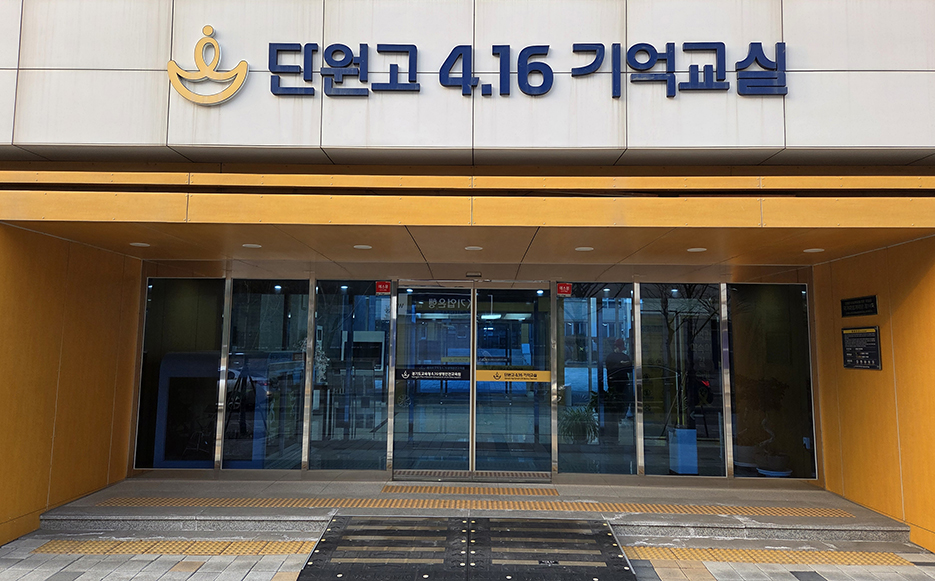
▲ Danwon High School 4.16 Memorial Classroom.
The Stories of the Students Still Remain in the Classroom
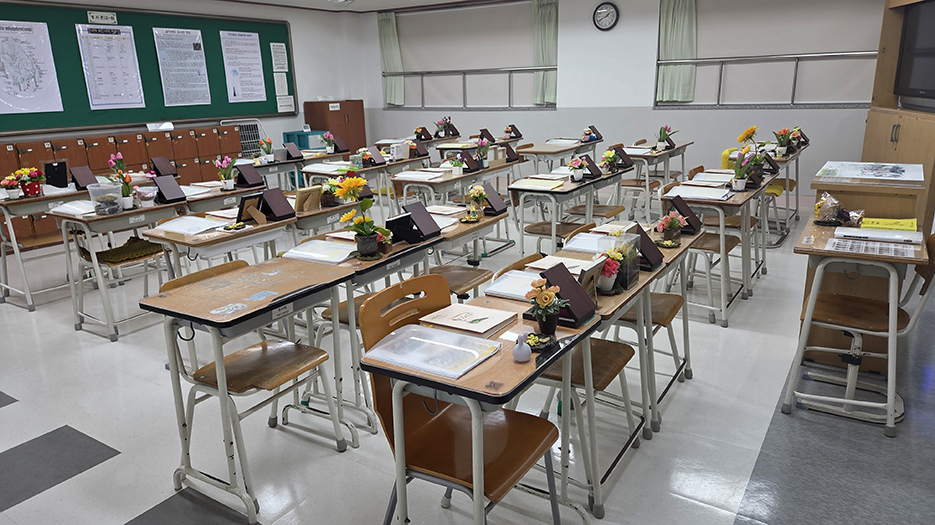
The first thing visible upon entering the classroom is two kinds of desks. Some are clean and empty, belonging to the students who survived. Others are covered with flowers and personal belongings—these are the desks of the victims. Textbooks and stationery left behind on the desks before the students departed for their school trip, along with blankets that once kept them warm, still remain in the classroom. Everything remains just as it was. Standing in a room filled with these belongings and memorial flowers, one cannot help but can feel a profound ache in the heart.
Turning from the desks, the blackboard and bulletin board come into view. The blackboard is covered with handwritten messages—words of remembrance and longing for the victims. On the bulletin board, there are a whiteboard, a class schedule, a meal plan, and other traces of daily life. Each item still bears the imprint of April 2014.
The Sewol Ferry Disaster, which the reporters had only known through news and articles, felt entirely different inside this classroom. It was a moment when the reporters remembered not just the 261 victims of Danwon High School as a mere number but their individual names. Thinking of them as friends, the reporters were able to sincerely remember and mourn each and every one of them.
The Sincerity of the Memory Classroom Guide
There was a guide in the Memory Classroom—a bereaved family member who has stood by the victims from the time of the Sewol Ferry Disaster to the present day. As she introduced the classroom, she called each victim by name and explained what dreams each student had and what kind of person each one was.
When the reporters asked how she could remember all of that, she paused in silence for a moment and answered, “That is because I read their brief biographies.” These can be read on site at the Danwon High School 4.16 Memorial Classroom or accessed online through the 4.16 Memory Archives website. Each biography records in detail the stories of the students who lost their lives in the Sewol Ferry Disaster—down to their smallest, most personal moments.
Reading through them, she engraved each child into her heart, as if they were her own. Yet she said it was not easy to read, as the stories brought back deep pain. The CBT reporters noted that the archive can continue to operate thanks to the dedication of people like her—those who see every victim as their own child.
Services for Visitors
As the records here are registered as State-Designated Records with the National Archives of Korea, leaving personal messages inside the classrooms is not permitted. Instead, visitors can leave their thoughts in the guestbooks placed on each student’s desk. Informational kiosks are available on each floor to help visitors navigate the space and explore the Memory Classroom in greater detail. Audio guide headsets are available on the first floor of the main building; the narration plays automatically when approaching certain spots. A sign language interpretation service is also available for the hearing impaired. On the same floor, there is a space offering free memorial items, along with a free four-cut photo booth. Visitors can take photos with the memorial items against a yellow butterfly backdrop—symbolizing the victims—as a way of expressing their remembrance.
Why Director Lee Ji-seong Remembers: The Reason and Meaning of Memory
The CBT reporters spoke with Director Lee Ji-seong, who has helped to preserve this place for the past 12 years, about the purpose and meaning of recording memories. Director Lee explained that the 4.16 Memory Archives is not limited to individual records of victims. “The Sewol Ferry Disaster was a social tragedy, marked by rescue failures, a culture of negligence toward safety, and the absence of disaster education. All citizens who witnessed that day are themselves witnesses and testifiers.” She added, “Recording the memories of victims, bereaved families, survivors, and citizens is a practice meant to ensure such a tragedy is never repeated.” In fact, these records have contributed to real social changes—mandatory survival swimming education, passenger ship ID checks, and the establishment of a unified LTE communication network.
Among the more than 230,000 records held by the 4.16 Memory Archives has, the ones that move Director Lee most deeply were the small traces left by the students. Notes exchanged with friends on their desks, a calendar marked with the date of the school trip, and in particular, the school trip schedule recovered from the Sewol Ferry belongings left a deep impression on her. Director Lee said the restored schedule feels like the heart of my beloved daughter, a victim of the disaster, who left for her school trip with joy and never came home.
What she hoped to convey to visitors is that “Life and death are not separated. Rather than remembering the victimized students only with sadness, I hope they will be remembered by their dreams and names.” Director Lee expressed a heartfelt wish that such accidents never occur again, saying, “Reflecting on these records, I hope people will embrace safety education as a daily and continuous practice and protect their lives through voluntary judgment, not external control.”
Please Help Keep the Memory Alive
The clocks in each classroom had stopped. Yet the memories there had not. If anything, they were moving more vividly than ever. In the memories of many, the tragedy of that day might be fading. However the 4.16 Memory Archives opens its doors today, as it does every day. Through the 4.16 Memory Archives website, the number of victims once known only through news come to feel like real people—with names, dreams, and daily lives. Remembering may be the smallest, but the strongest action one can do. A visit to the archives is one way to take part in that act of remembrance.
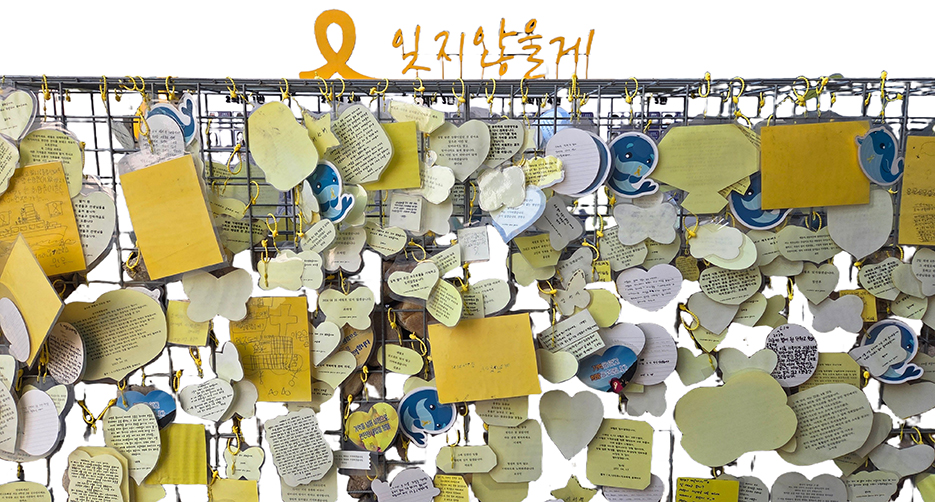
▲ It is said “I will never forget.”
By Bae Young-jun | byj1399@chungbuk.ac.kr
By Kang Yeo-min | yeomin@chungbuk.ac.kr


 Quick News