The Chungbuk Times > People > View
What You Need to Know: Pseudo-Religious Recruitment on Campus
제 229 호 발행일 : 2026.09.07
Every semester, as the new term begins, a wide range of religious and faith-based groups carry out recruitment activities on campus. Among them, certain groups have drawn social concern because of the tangible harm they cause to their members. According to a 2021 study by Roh Yeon-sang titled “Current Status and Countermeasures of the Crimes of the Pseudo-Religious,” such groups as “pseudo-religions” are defined as emerging religious sects or denominations that outwardly resemble established religions while promoting antisocial doctrines that induce maladaptive behavior in their followers. As reports of campus-related harm continue to surface, a CBT report sat down with Pastor Lee Geum-yong of the Cheongju Cult Counseling Center to examine the specific recruitment tactics employed, the difficulties faced by those affected, and the measures needed to address them.

Q1. Please introduce yourself and your counseling center.
I am Pastor Lee Geum-yong, serving at the Cheongju Cult Counseling Center and New Life Church. Our center helps people in the Chungbuk region who have suffered from pseudo-religion free themselves from that bondage, and also carries out preventive activities to keep people from falling into pseudo-religion in the first place.
Q2. Why do cases of harm persist despite university students already having access to information about pseudo-religion?
As pseudo-religion constantly researches and develops new methods of deceiving people, superficial knowledge of pseudo-religion gained from the internet or media is not enough to keep someone from falling for such deception. Pseudo-religious groups initially conceal their affiliation when approaching people, and continue educating the target until indoctrination is complete. Once someone has been brainwashed, the group instills in them a false conviction of salvation, and they are unable to leave the group even after they come to know that the group is a pseudo-religion.
Q3. What new or increasingly sophisticated recruitment tactics have you seen recently on campus?
Pseudo-religious groups approach university students without revealing any religious affiliation at all, instead exploiting students’ psychological anxieties, current trends, and interests in employment and culture through means such as psychological tests: Myers-Briggs Type Indicator (MBTI) and Enneagram Test, surveys, disguised clubs and small-group gatherings, and overseas volunteer or language-exchange programs. This is where the seriousness of the problem lies.
Q4. What patterns do you see in how victimized students are first approached and how initial relationships are formed, and what secondary harm results from this?
In the case of certain pseudo-religious groups, recruitment is carried out under a so-called “doctrine of deceptive strategy” that holds that it is permissible to lie in order to evangelize. Once a recruitment target is identified, the group works to gather as much information about that person as possible. The group is then systematically organized to approach the target under the guise of a chance encounter. Members may pose as department seniors, alumni, pastors, or missionaries. After building a sense of closeness this way, the ultimate goal is to lead the target into a stage of Bible study designed to indoctrinate them into the group’s teachings.
Students who come to our center typically request counseling after about three to five months of being lured into studying the Bible under a pseudo-religious group. Some seek counseling before being fully brainwashed, after learning through various channels—such as hearing it from someone within the group—that the group is a pseudo-religion. Others, who had previously studied the Bible systematically at a mainstream church, seek counseling after sensing that what they are being taught differs from the biblical knowledge they already had. When a family member falls into a pseudo-religion, conflict and discord can arise within the family, because those brainwashed by a pseudo-religious group can no longer carry on normal conversation. In such cases, seeking help from a verified counseling center specializing in pseudo-religion is necessary.
Reported harm between 2021 and 2025 includes 14,000 cases of family breakdown, 24,000 cases of financial damage, 150 cases of sexual violence and exploitation, and more than 6,000 cases of psychological harm occurring every year. Experts believe the actual number of cases is far higher when unreported incidents are included.
Q5. How does the perception that “I am not interested in religion, so I will be fine” or “Going once or twice cannot hurt” differ from reality?
It is a serious miscalculation to think that having no interest in religion, or attending just once or twice to learn about it, will be harmless. As mentioned earlier, pseudo-religious groups constantly research and refine their methods of deceiving people. Some say they attend meetings of a pseudo-religious group in order to evangelize its members, but this too is a dangerous line of thinking. Pseudo-religious groups generally distort Scripture through allegorical interpretation, and once someone falls into that trap, they inevitably end up on the path to brainwashing. Pseudo-religious groups should never be underestimated.
Q6. For students who have already attended meetings or provided personal information, what difficulties do they face in trying to end the relationship, and what practical steps can they take?
For students who have attended several meetings or already provided personal information, ending the relationship becomes difficult if they are indecisive by nature or have already formed a close bond with members of the pseudo-religious groups. If they cannot cut off these relationships decisively, they will continue to be gaslighted and live a life controlled by others. In particular, pseudo-religious groups that have a cult leader may lead their followers to worship that leader as a savior, messiah, or God, and the followers end up spending their lives in that tragic condition. “In reality, cult leaders are only human; they will die too. Ultimately, they are nothing more than religious con artists.”
Q7. Are there clear limitations or gaps in how universities and the legal and institutional system respond to this problem?
Because pseudo-religious groups conceal their identity or invoke freedom of religion to form clubs and small groups, there are limits to how effectively they can be stopped. In my view, the most effective way to block and remove pseudo-religious deception on campus is for Christian student clubs and church college ministries to unite, seek advice from verified experts on pseudo-religion at institutions such as the Korea Christian Cult Counseling Association, and develop and carry out response measures together. Christian student clubs and church college ministries should also invite pseudo-religion experts to hold educational sessions to prepare students in advance, and protect them from such groups.
Q8. What message would you like to share with students and readers at CBNU?
As recorded in Scripture, pseudo-religious groups deny that salvation comes by grace through faith in the gospel alone, and instead teach that a person can only be saved by fulfilling certain requirements that the group demands; that is precisely their means of exploitation. Therefore, students must learn about pseudo-religion and prepare themselves so that they are not deceived by such groups. What I have come to realize through counseling on pseudo-religion is that, when interpreting Scripture, these groups completely disregard context, the original languages, grammar, and the historical, cultural, and everyday backdrop against which the Bible was written—instead quoting only certain isolated verses and distorting or denying them through allegorical interpretation.
For this reason, Bible study should only be done at a church belonging to a recognized denomination or at an objectively verified Christian club, and should never be undertaken with an unfamiliar club, small group, or in an office or cafe.
As the new semester brings a variety of clubs and gatherings welcoming students across campus, particular caution is warranted when dealing with unfamiliar groups or approaches that request excessive personal information. It is worth remembering that a friendly senior, a chance encounter, or an interesting psychological test can all be the starting point of pseudo-religious recruitment. If you feel uneasy in an unfamiliar gathering, do not ignore that instinct—a wise choice is to immediately seek help from someone you trust or a verified counseling institution.
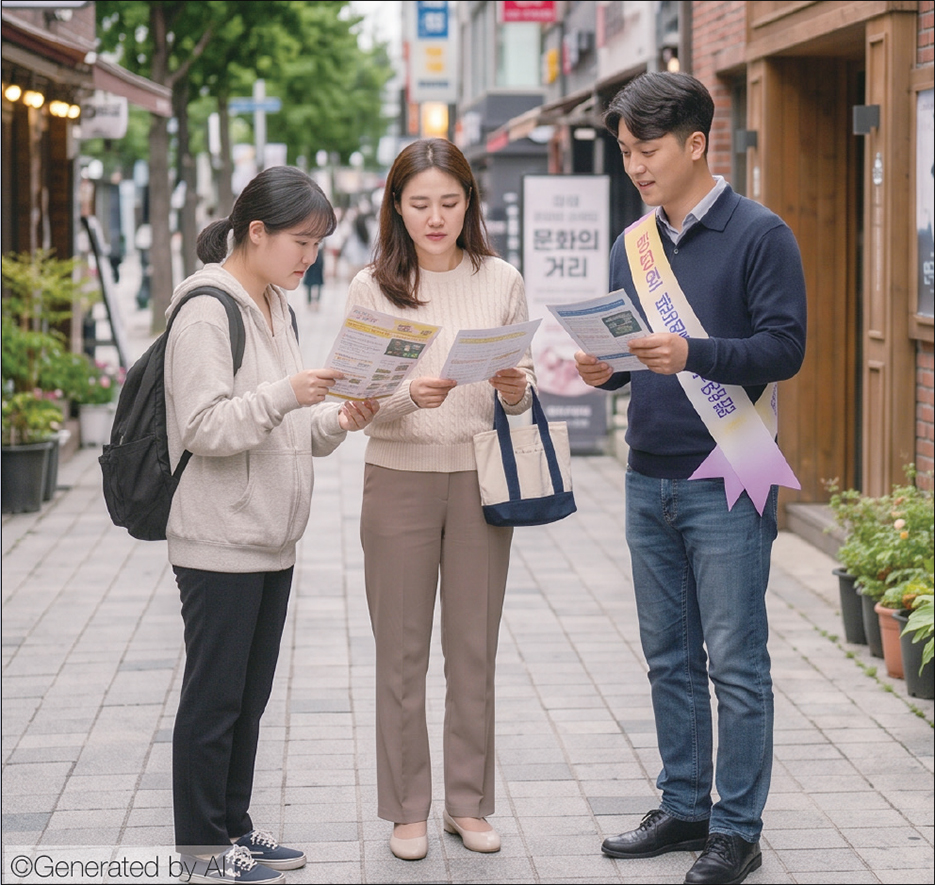
▲ Scene of Pseudo-Religious Recruitment
By Bae Yeong-jun
hangeul1399@chungbuk.ac.kr